I’m on a mission to perfect the pie crust.
It’s one of those things I feel I must conquer. If I want to consider myself a baker.
Pie dough has always been a major pain in my side.
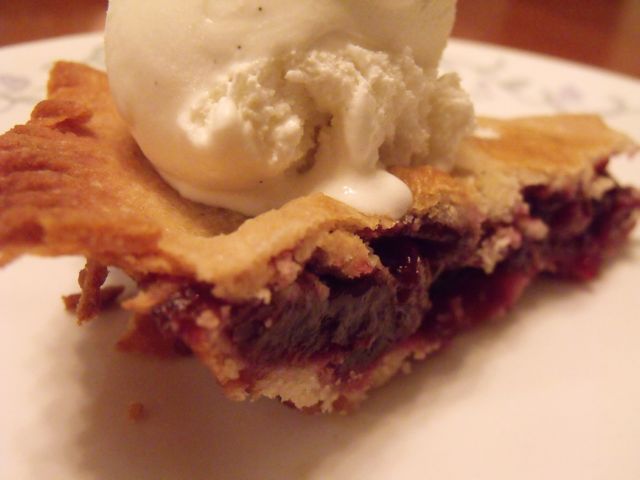
I’ve tried using all shortening, all butter, butter-flavored shortening, and various combinations of the two. (Haven’t tried lard yet. The huge tub o’ lard at Food Lion scares me.)
I’ve tried chilling the fat, and I’ve tried using room-temperature fat.
I’ve tried cutting in the fat with the food processor, with a fork and with my fingertips.
I’ve tried using an egg in the dough.
I’ve tried immediately rolling out the dough, refrigerating the dough and freezing the dough.
Right around the rolling-out-and-transferring-to-pie-plate stage, it starts to break down. It rips. It sticks. It won’t hold together.
Well, a couple weeks ago I bought John T. Edge’s “Apple Pie” at Books-a-Million’s $1 sale. $1 well spent! One of its recipes contains two methods that gave me a huge dose of pie crust self confidence:
1. Using a spray bottle to spritz in ice water.
2. Banging — not rolling — out the dough.
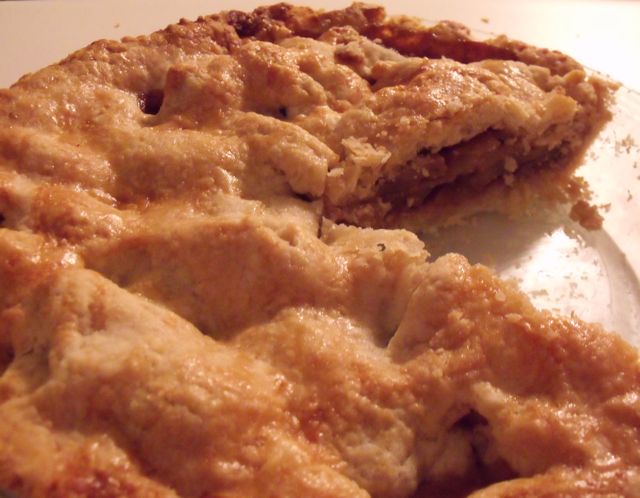
These tips were right-on, because it’s the best crust I’ve ever made. Could I improve? Sure. Next time, perhaps, the lard.
Here’s the recipe, in case you’re interested:
Karen Barker’s Pin-Rattling Piecrust
2 3/4 cups all-purpose flour
3/4 teaspoon kosher salt
3/4 tablespoon sugar
4 ounces butter, chilled and cut into pieces
4 ounces vegetable shortening, chilled and cut into pieces
1/4 to 1/2 cup ice water, chilled in a squeeze bottle or spray bottle
Pulse flour, salt and sugar in a food processor until blended. Add butter and shortening and pulse 12 to 14 times or until the mixture looks like clumpy sand. Transfer mixture to a large bowl and gradually spray in enough cold water to form a cohesive and evenly moistened dough that is still not sticky. Work quickly, tossing and stirring with a fork until dough begins to come together. Divide dough in two. Shape each half into a flattened round. Wrap in plastic and chill in the refrigerator for several hours or overnight. To prepare dough for the pie plate, lay down a sheet of wax paper. With a rolling pin, bang out the rounds into crusts, making initial impact at the centermost point before stroking it quickly outward. Life the pin each time before whacking it again. Ten or twelve spankings should do it.
One more thing I really liked about Edge’s book. This little story about Karen Barker, the owner of Magnolia Grill in Durham:
A gentleman lawyer and avid eater who lives near the Barkers … says, “You know, she’s not really a pastry chef. She’s more of a baker.” When I profess to be unaware of the distinction, he tells me that a pastry chef is more of a high-wire act. A pastry chef takes chances. What Karen does is not dramatic or inventive enough to be called pastry work.
… I call Karen and tattle on him. … But Karen just sighs. “If a pastry chef wants to build a spun-sugar cage around a slice of apple pie, that’s fine by me,” she says. “Besides, baker sounds forthright and honest. I like that.”

 Nicole M. Markle
I’m on the same page these days. It’s fussy, but Christopher Kimball’s crust in The New Best Recipe book by the Cooks Illustrated crew worked just right with my shot at a lemon meringue pie this past weekend. It gets kind of dusted up with graham cracker crumbs, browns nicely and holds all that lemon custard in place.
http://srvlibpac.nhcgov.com:8080/#section=resource&resourceid=2279326¤tIndex=0